Heatizen: A Chillingly Effective Horror Display Font for Crafters
If you’ve ever spent hours tweaking a candle label only to realize the font doesn’t *feel* like your brand—too friendly, too clean, too… safe—you know how much weight typography carries in handmade goods. That’s why Heatizen stopped me mid-design. It’s not just another spooky font. It’s a thoughtfully crafted display font built for makers who sell physical products rooted in mood, story, and atmosphere—think gothic apothecary labels, haunted house invitations, boutique Halloween packaging, or farmhouse-chic signs with a dark twist.
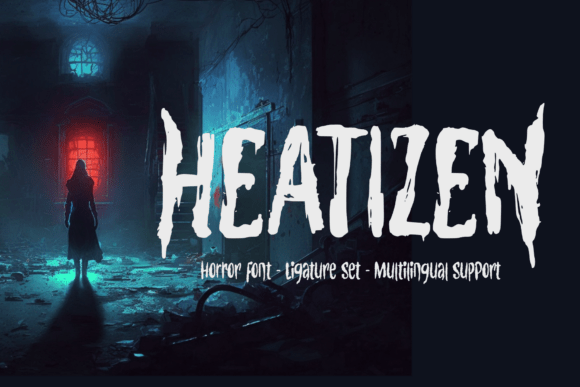
Visually, Heatizen balances eerie charm with real-world usability. Its hand-drawn character gives it organic texture—slight unevenness in stroke weight, subtle ink bleed effects, and deliberate asymmetry—but it never sacrifices legibility. Unlike overly distressed fonts that vanish at small sizes or blur when cut on a Cricut or Silhouette, Heatizen holds crisp detail even at 12–16pt on product tags or 3” sticker die-cuts. The letters have presence without being cartoonish: think vintage horror movie posters meets modern craft sensibility—not campy, not generic, but deeply intentional.
For physical product creators, Heatizen shines where impact matters most: short phrases, titles, and focal words. Use it for “Witch’s Brew” on soy candle jars, “Do Not Disturb (The Spirits Are Resting)” on ceramic mug decals, or “October Nights” on printable wall art sold as digital downloads. It works beautifully on kraft paper labels, matte black stickers, and rustic wood signs—especially when layered over subtle textures like grain, parchment, or charcoal smudge overlays. Because it’s designed as a display font, avoid long paragraphs—but that’s exactly what makes it perfect for your best-selling product lines: names, flavors, warnings, welcome messages, and seasonal slogans.
I’ve tested Heatizen across multiple production workflows—and it delivers. On my Cricut Maker 3, it cut cleanly at 0.125” height on vinyl (with slight overcut adjustment), and on my Epson EcoTank, it printed sharp on both glossy and uncoated cardstock. For SVG designers, the vector-friendly outlines translate smoothly into cutting files—no jagged edges or collapsed nodes. And because it includes standard OpenType features like stylistic alternates and ligatures (like the dramatic “th” combo or ornamental “&”), you can add subtle variation to repeated designs—say, rotating between two versions of “Haunted” across a set of 12 printable planner stickers.
What sets Heatizen apart from other horror fonts is its commercial practicality. It comes in OTF and TTF formats—no web-only restrictions—and supports extended Latin characters, so you can confidently use it for bilingual boutique tags (e.g., “Potion • Poción”) or international Etsy listings. Just verify your license covers physical resale and digital templates—most premium font licenses do, but always double-check before bundling Heatizen into editable Canva templates or SVG bundles for crafters.
Pairing Heatizen thoughtfully expands its versatility. Try it with a soft, rounded sans serif (like Quicksand or Nunito) for contrast that feels modern and approachable—ideal for wedding stationery with a dark romance theme (“Eternal Love • Bound by Moonlight”). Or layer it over a delicate script font for invitation headers, then drop down to a clean serif (like Cormorant Garamond) for body text. That combo reads as elevated, intentional, and commercially polished—not gimmicky. For product packaging, I often use Heatizen for the flavor name (“Midnight Fog”), then switch to a minimalist sans for net weight, ingredients, and barcode placement. That hierarchy tells customers: this is special, but still trustworthy.
Real-world examples? Yes—here’s what’s working in my shop right now:
- Candle labels: Heatizen on matte black sticker stock, paired with copper foil accents—customers consistently comment on how “moody yet elegant” the branding feels.
- Digital printables: “Grimoire Pages” planner inserts with Heatizen headers and gentle line-art borders—downloads convert well during October and around Samhain.
- Farmhouse signs: Laser-engraved on walnut, using Heatizen for the main phrase (“Beware the Full Moon”) and a thin sans for the date—adds narrative depth without overwhelming the material.
- SVG bundles: Heatizen-based Halloween greeting cards (with layered shadows and optional “blood drip” swash alternates)—sold alongside coordinating frames and clipart in coordinated color palettes.
- Boutique tags: Heatizen on recycled kraft hang tags for artisan soap—paired with a handwritten-style font for scent notes (“Lavender & Grave Soil”)—creates instant shelf appeal.
Readability tips for crafters: At under 0.25”, stick to uppercase or title case for maximum clarity on small stickers or jar labels. Avoid all-lowercase usage—it loses definition at tiny sizes. When mocking up for Etsy previews, preview at actual print size (not zoomed-in) and check grayscale mode—Heatizen maintains tonal contrast even without color. And if you’re laser-cutting or engraving, simplify complex alternates first; sometimes the base glyph cuts more reliably than a swash-heavy version.
As a maker who sells both physical goods and digital design assets, I value fonts that do double duty: they must stir emotion *and* survive production. Heatizen does both. It deepens brand identity without alienating buyers—it’s spooky enough for a haunted escape room’s merch line, refined enough for a luxury gothic bridal boutique. It’s not about shock value. It’s about resonance. When your customer sees “Heatizen” on a label, they don’t just read the word—they feel the atmosphere. And in handmade commerce, that feeling is what turns a one-time buyer into a repeat fan.
Whether you're designing printable Halloween party kits, curating boutique packaging for herbal tinctures, or building a cohesive SVG collection for Silhouette users, Heatizen isn’t just another horror font. It’s a reliable, expressive, commercially smart display typeface—crafted for creators who understand that great typography isn’t decoration. It’s part of the product.